2026 DMH Awards

Room: Paradise Ballroom

2026 Spring Training Institute Outstanding Performer Awards 


The Department of Mental Health, Division of Behavioral Health, is recognizing two categories of Outstanding Performers this year: Recovery Support Services and Supported Employment.  These awards go to agencies that exemplify the DMH Mission of serving, empowering and supporting Missourians to live their best lives. 


The 2026 Outstanding Performer Award for Recovery Support Services is Amethyst Place. 

Outstanding Performer for Recovery Support Services is awarded to an organization whose work is transforming lives not just for today, but for generations to come. 

Amethyst Place is a long-term supportive housing program in Kansas City that provides safe, fully furnished homes across 69 apartments for mothers in recovery and their children, offering stability without a time limit so families can heal at their own pace. With an on-site pantry, childcare, and teen-centered programming, the organization creates a supportive environment where families can truly rebuild. Grounded in a two-generation, family-centered model, Amethyst Place recognizes that substance use, poverty, and trauma impact both mothers and their children, and addresses these challenges together through on-site therapy, parenting and life-skills education, and career development support—because they believe it costs more to do nothing, and they have chosen to change that. 

For 25 years, Amethyst Place has been a national leader in long-term, transformational care—allowing families to stay as long as needed, with an average length of stay of 28 months. Its outcomes are powerful: 90% of graduates since 2020 remain stably housed, 95% of children in out-of-home placement are reunified with their mothers—far exceeding the national average—and 88% of women are employed, in school, or both, up from just 40% at intake. Through this comprehensive and compassionate approach, Amethyst Place is not only helping families recover, but empowering them to build resilient, stable, and independent futures. 

Please join me in recognizing and celebrating the extraordinary impact of Amethyst Place and their unwavering commitment to strengthening families and communities. 


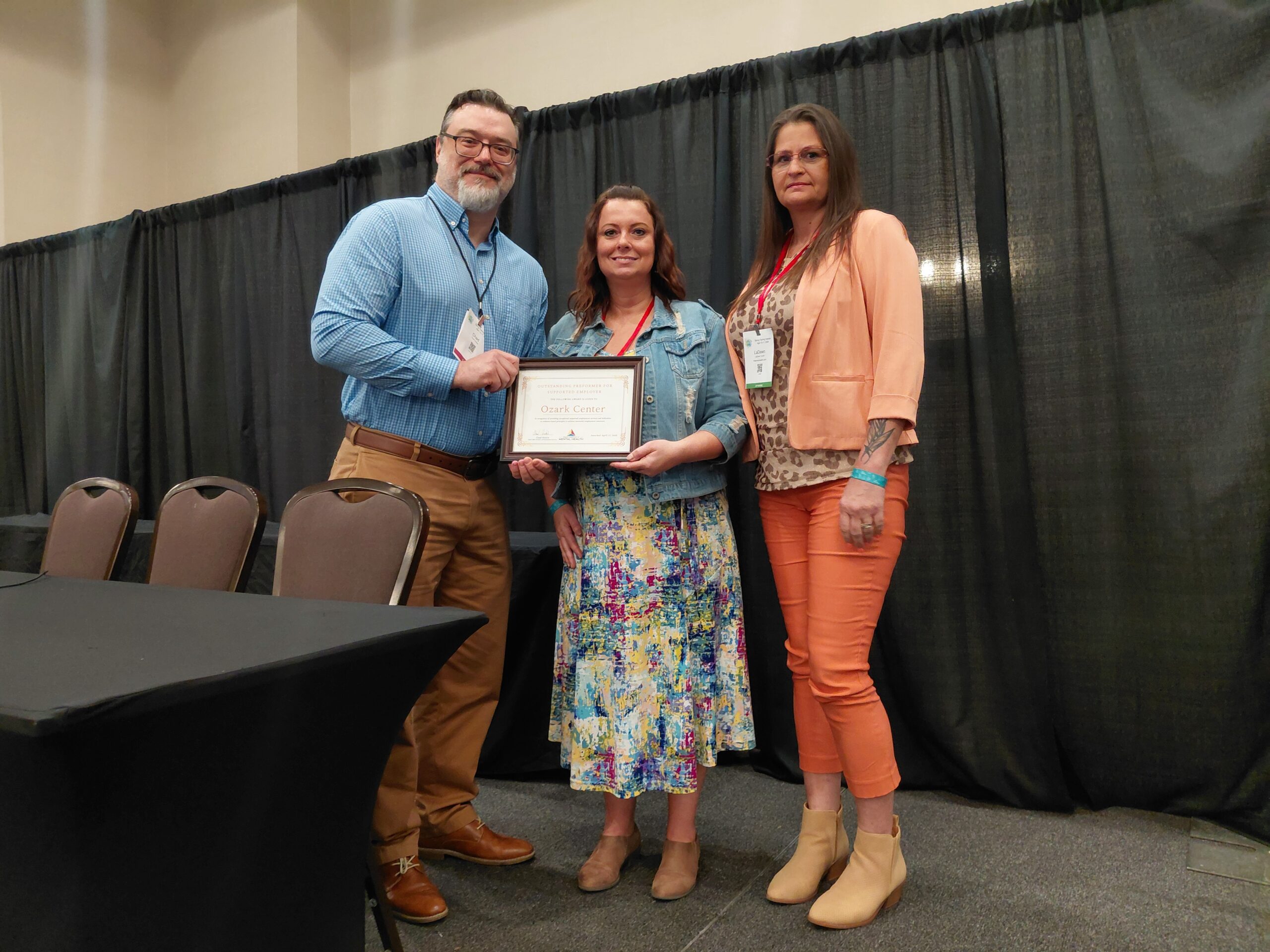
The 2026 Outstanding Performer Awardee for Supported Employment is Ozark Center. 

Ozark Center has demonstrated strong adherence to the evidence-based practice of supported employment known as Individual Placement and Support (IPS). At their most recent IPS fidelity review, Ozark Center scored in the exemplary range of fidelity. While commitment to the fidelity model is essential, Ozark Center also has some of the highest employment outcomes in the state.  They overcame staffing challenges to continue to provide excellent supported employment services. They understand the profound impact employment has on an individual’s recovery.  They exhibit innovative practices, such as having their IPS employment program located near their Clubhouse program, which enhances integration within their agency and increases referrals and offer employment to those who may not have considered it previously. 

A successful employment program must have strong collaboration among a diverse group of partners including the Division of Behavioral Health, Vocational Rehabilitation, and community employers. Along with recognizing Ozark Center, we want to acknowledge the outstanding contributions of their Vocational Rehabilitation partners including Kierstan Shamhart. Their steadfast support of IPS is a major factor contributing to Ozark Center’s prosperity. The Vocational Rehabilitation partners had this to say about Ozark Center: “Ozark Center continues to push forward and develop strategies and processes to ensure that the supported employment services are being provided to the clients they serve through IPS. Ozark Center’s team aspect is one that is inviting, encouraging, and supportive. Their work in creative employment placements, supports through the process of gaining and maintaining employment, and the integrated efforts of employment throughout Ozark Center as a whole makes the program effective and successful. I am very proud to be a part of the team and to have had the opportunity to work with them over the last 11 years.” 
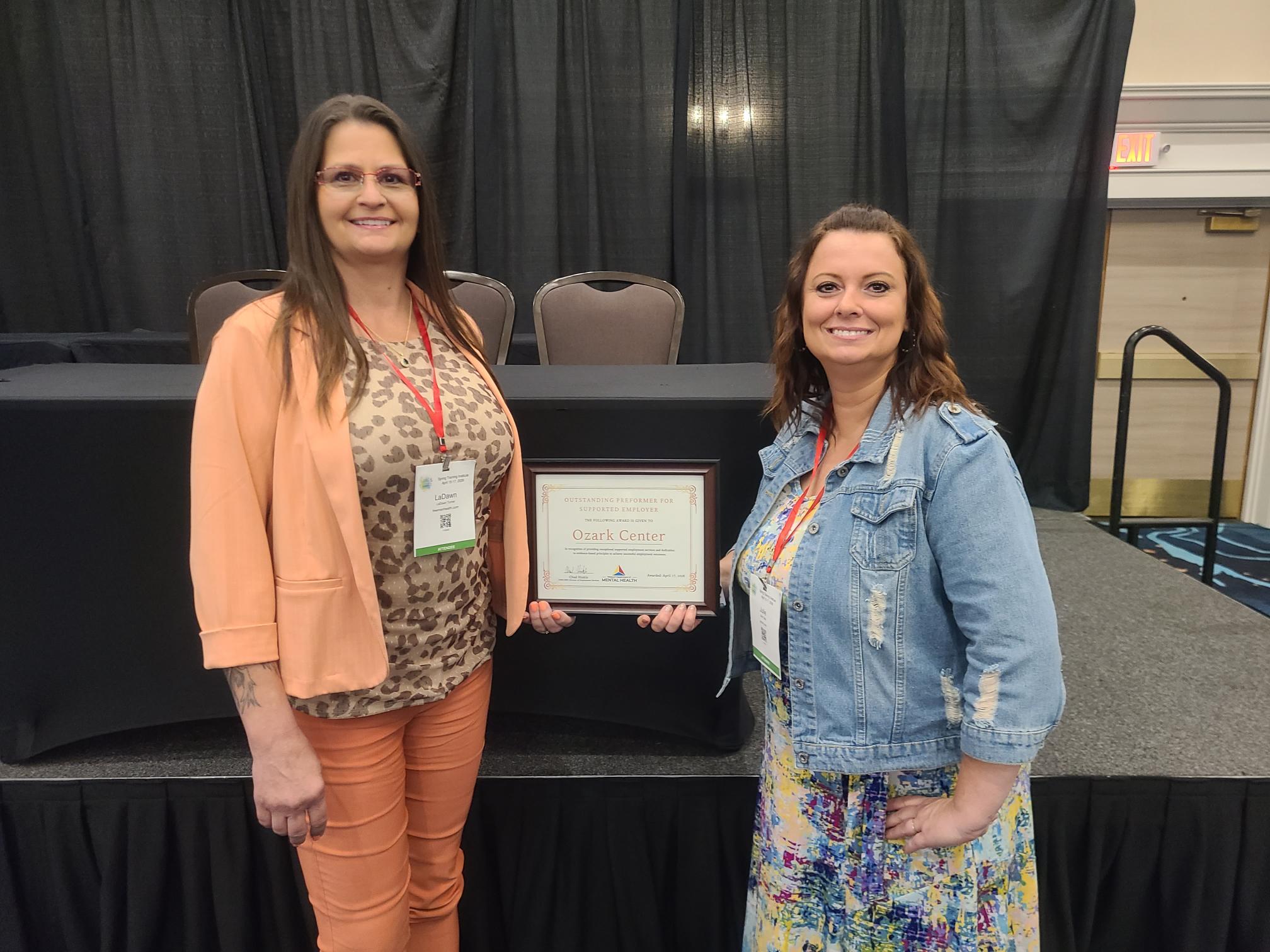
Two women standing in front of a stage, smiling at the camera. One woman holds a framed certificate that reads Ozark Center. Both are wearing conference badges around their necks. Three people stand together indoors. The man on the left and two women are smiling while the woman in the center holds a certificate. They are standing in front of a black curtain with empty chairs beside them.


2025 Spring Training Institute Outstanding Performer Awards

Paradise Ballroom ABC


The Department of Mental Health, Division of Behavioral Health, is recognizing three Outstanding Performers for Housing, Supported Employment, and Recovery Support Services.  These awards go to agencies that exemplify the DMH Mission of serving, empowering, and supporting Missourians to live their best lives.


The Department of Mental Health, Division of Behavioral Health, is recognizing three categories of Outstanding Performers this year: Recovery Support Services, Supported Employment, and Housing.  These awards go to agencies that exemplify the DMH Mission of serving, empowering and supporting Missourians to live their best lives. 


The 2025 Outstanding Performer Award for Recovery Support Services is Recovery Lighthouse. 

Recovery Lighthouse is a Recovery Support Access Site managing vouchers for the Central Region of the state.  They provide an array of recovery support services, including counseling, support groups, housing, and peer coaching.  They have developed the curriculum for the Family Recovery Program and have generously trained other providers on this model.  They started two new Recovery Community Centers in 2024: Beacon of Hope Recovery Community Center in Sedalia and The Pier Recovery Community Center in Warrensburg.  These new Recovery Community Centers are already a valuable resource in their communities. 

Pictured accepting the award for Recovery Lighthouse is Adriatik Likcani, Executive Director, and his recovery team. 

Six people stand together, smiling at the camera. One man in a suit is holding an award. The group is dressed in business or business casual attire, posing in front of a black curtain backdrop. 

The 2025 Outstanding Performer Awardee for Supported Employment is FCC Behavioral Health. 

FCC Behavioral Health has demonstrated a strong commitment to implementing the evidence-based practice of supported employment known as Individual Placement and Support (IPS).  FCC Behavioral Health has consistently scored in the highest range of fidelity to the IPS model and has one of the highest employment outcomes in the state.  They have initiated innovate practices and shown great ambition in offering IPS services to rural/underserved areas.  FCC has a strong collaborative partnership with Missouri Vocational Rehabilitation. 


Pictured accepting the award on behalf of FCC is Aaron Floyd, IPS Supervisor, and the FCC team. 

Five people stand in a row in front of a black curtain; two men on the right shake hands while one holds an award. All are dressed in business casual attire and are smiling at the camera.

Four adults stand together indoors on a blue-patterned carpet. One man holds an award. A black stage with steps and a black curtain is behind them. All are smiling and wearing conference badges.

 The 2025 Outstanding Performer Awardee for Housing is FCC Behavioral Health. 


FCC Behavioral Health offers a variety of housing services for persons experiencing homelessness who suffer from mental health or substance use disorders.  FCC Behavioral Health has a variety of innovative housing programs including Permanent Housing Program (PHP), Cape Women and Children’s Program, SEMO Safe Haven, New Beginnings, Housing Liaison, PATH and assist with Shelter Plus Care.  FCC Behavioral Health is an early adopter of best practices and continuously looks for new opportunities to expand services and options. 


Pictured accepting the Housing award for FCC Behavioral Health is Noble Shaver and Tammie Bratton. 

Three people stand together smiling in front of a black curtain. The woman in the center holds a glass award, while the man on the left and woman on the right stand beside her. All are wearing name badges. 


Reese, Sandra, BS

Sandra Langfitt Reese is a trainer and consultant for The IPS Employment Center at Research Foundation Mental Hygiene (RFMH) Columbia University. Since 2006, Sandra has assisted with providing system conversion and capacity building in provision of integrated employment services with states, counties, and countries within the International IPS Learning Community, which includes 27 states, counties and 7 countries serving individuals with mental health conditions. She has also assisted counties and states outside of the IPS Learning Community with pilot projects to demonstrate the effectiveness of IPS.
Sandra has worked as an IPS supervisor for 10 years, as a statewide IPS trainer for the Oregon Supported Employment Center for Excellence and she worked in community mental health for over 25 years as the director of supported employment and education.
Presentation(s):

How Does Providing Evidence-based Supported Employment IPS Impact Social Determinants of Health?

Room Leeward 76-77


Speaker(s): 

Sandra Reese, BS

Description: 

According to the World Health Organization, people with serious mental health disorders die 10-25 years earlier than the general population. This session will explore why employment is a critical mental health intervention and what leadership and mental health practitioners can do to promote employment.

Objectives

  • List at least two reasons why employment is a critical mental health intervention
  • List at least three reasons why employment isn’t seen as a central focus of the public mental health system.
  • List four strategies for how to promote employment within the public mental health system.

Young-Walker, Laine, MD

Laine Young-Walker, MD is a Diplomate of the American Board of Psychiatry and Neurology in General Psychiatry as well as Child and Adolescent Psychiatry. She currently serves as Associate Dean for Student Programs at the School of Medicine, Chair of the Department of Psychiatry and is a Professor of Psychiatry, at University of Missouri School of Medicine.
She has worked locally and statewide to create programs which help children and families in the community. These programs focus on access to child psychiatry, prevention/early intervention in young children, trauma initiatives and support for child well-being. They include Boone County: Early Child Coalition (BC-ECC), Early Childhood-Positive Behavior Supports program (EC-PBS), the Child Trauma Institute (CTI), Bridge: School-Based Psychiatry, the Missouri Child Psychiatry Access Project (MO-CPAP), the Missouri Maternal Health Access Project (MO-MHAP) and the Center for Excellence in Child Well-Being.
Presentation(s):

Supporting Complex Needs using Tiered Supports

Room Nautical Wheeler


Speaker(s): 

Kathleen Deppeler, BA

Description: 

The Missouri Department of Mental Health uses Tiered Supports, based on a public health model created by the CDC. This model supports the health of an entire population of people by providing a continuum of supports that are layered on top of one another as a person’s needs increase. Learn more about how structuring supports by tiers relates to individuals, strategies, and organizations as a whole.

Objectives

  • Participants will understand how a tiered framework relates to people, interventions, and organizations
  • Participants will understand how a tiered framework improves outcomes community wide
  • Participants will know how to access free PBS resources from the Department of Mental Health to improve relationships, behaviors, and environments through positive practices.

Deppeler, Kathleen, BA

Kathleen Deppeler is the Director of Positive Supports for the Missouri Department of Mental Health- Division of Developmental Disabilities. The Positive Supports team provides professional development, coaching, and consulting around the implementation of Positive Behavior Support (PBS) systems. Kathleen joined the Tiered Supports team in 2013, and has continually focused on increasing organizational capacity to support people with complex needs. She has a Bachelor’s of Arts in Human Services and minor in Sociology from Fontbonne University in St. Louis and has trained, coached, and mentored Tools of Choice implementers and facilitators since 2013. She was recognized as the 2018 Crisis Intervention Training Instructor of the Year by the Mid-America Council for her focus on ensuring training competency through role play practice and feedback.
Presentation(s):

Behavioral Health Ethics for Private Practice

Room Paradise Ballroom B


Speaker(s): 

Terri Cooley-Bennett, LCSW, LSCSW, CCDP-D, TTS

Description: 

Providing clinical services to vulnerable populations is a common responsibility for practitioners in private practice. Because of the unique challenges experienced, opportunities for ethical dilemmas and even ethical complaints are not uncommon. It is of utmost importance that professionals abide by ethics codes, practice ethically, and apply models of decision making when ethical dilemmas and complaints arise in practice.
This workshop will provide an overview of common ethical principles and will examine the current trends and research regarding ethical complaints and dilemmas in practice and will discuss strategies for preventing and managing these. This workshop meets the ethics requirements for licensure.

Objectives

  • Provide overview of common ethical principles related to behavioral health practice
  • Discuss trends and current research regarding ethical complaints in counseling practice and behavioral health with a focus on private practice
  • Examine strategies and best practices for preventing and managing complaints and ethical dilemmas in practice

Beck, Niels, PhD

Niels C Beck received his PhD in Clinical Psychology from St. Louis University. Currently, he works as a consultant to the State Hospital in Fulton and assists with a variety of applied research and quality improvement projects. Previously, he was a tenured full professor at the University of Missouri Medical School, where he served as vice-chair of the Department of Psychiatry. Dr. Beck and his colleagues at Fulton have done work related to inpatient aggression since the early 1990s.
Presentation(s):

Choate, Alexandria, MA

Allie Choate is a doctoral candidate in clinical psychology at the University of South Florida. She is currently completing her pre-doctoral internship at Fulton State Hospital. Her research focuses on understanding developmental mechanisms that foster the development of borderline personality disorder (BPD) traits, as well as their co-occurrence with other forms of psychopathology and problematic behavior, such as substance use and aggression.
 

Presentation(s):